
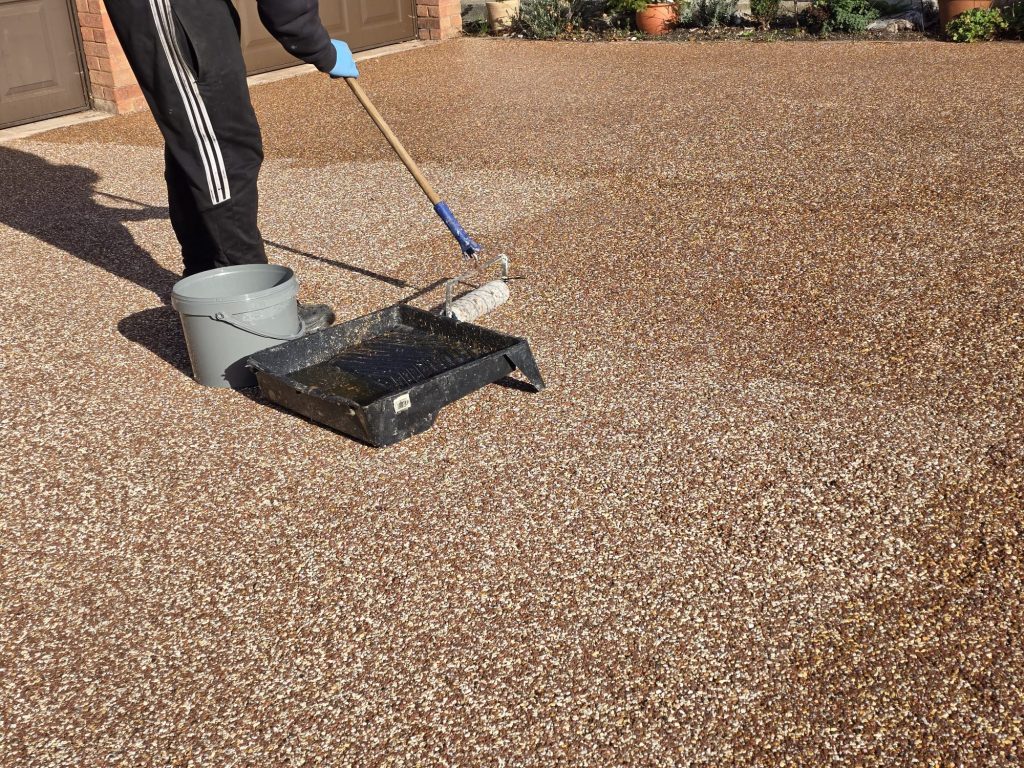
Has Your Resin Driveway Lost Its Colour? A Professional Clean and Reseal Can Bring It Back to Life
When a resin bound driveway is first installed, one of its most attractive features is the depth and variation of colour in the natural stone. Golds, greys, reds, creams and darker aggregates all stand out, giving the surface its distinctive appearance.
After several years, however, homeowners often contact us because they believe their resin driveway has faded or lost its original colour.
The good news is that in many cases, the stone hasn’t actually lost its colour at all.
Years of dirt, traffic film, algae, moss, atmospheric contamination and general weathering can gradually dull the surface. At the same time, the original resin at the top of the aggregate can become weathered and lose some of the rich appearance it had when first installed.
A professional deep clean followed, where appropriate, by a polyurethane reseal can make a remarkable difference.
Where Has the Colour Gone?
Resin bound surfacing is manufactured using naturally coloured aggregates mixed with a clear resin binder.
This means that the colour you see isn’t simply a paint or coloured coating applied to the driveway. Much of the appearance comes from the actual stone itself.
Over time, contaminants build up around and between those stones.
A driveway that originally contained warm gold, brown and cream aggregates can gradually appear grey and lifeless. Lighter surfaces can become dirty and patchy, while darker mixtures can lose some of their original depth.
This can happen so gradually that the homeowner doesn’t realise how much the appearance has changed.
Step One: A Proper Deep Clean
Before considering resealing, we first need to establish the actual condition of the resin surface.
A professional clean removes years of accumulated contamination and begins to expose the original aggregate again.
Depending on the condition of the driveway, this can include treatment for:
- General dirt and traffic film
- Moss and algae
- Organic contamination
- Tyre marks
- Oil and vehicle contamination
- Leaf staining
- Localised marks and staining
Pressure washing resin bound surfacing needs to be carried out correctly. Simply putting a powerful pressure washer close to the surface is not the answer.
Excessive pressure or an aggressive concentrated jet can potentially damage an ageing resin surface or loosen exposed aggregate.
We use controlled cleaning methods designed to remove contamination while protecting the existing resin bound surface.
Sometimes the difference after cleaning alone is dramatic.
Step Two: Assessing the Resin After Cleaning
Once the driveway is clean, we can properly inspect it.
Not every resin driveway needs to be resealed.
If the existing binder is still in excellent condition and cleaning has restored the appearance, further treatment may not be necessary.
However, on older surfaces we may find that the top of the aggregate has become dry-looking, the original sheen has disappeared, or some areas are beginning to show signs of surface wear.
This is where a suitable polyurethane resin reseal can make a significant difference.
What Does Resealing Do?
A clear polyurethane reseal coats the exposed contact points of the aggregate and refreshes the appearance of the existing resin surface.
One of the most noticeable effects is the return of depth of colour.
Think about what happens when you wet a decorative stone.
When dry, the stone can look relatively pale and flat. Once wet, its colours immediately become deeper and richer.
A suitable clear resin treatment can create a similar visual effect, enhancing the natural colours of the aggregate rather than painting over them.
Greys become deeper, golden aggregates become warmer and multi-coloured blends regain much of the contrast that originally made them attractive.
Cleaning and Sealing Work Together
Applying a new coating over a dirty driveway is not a proper restoration.
The surface needs to be thoroughly cleaned and appropriately prepared first.
Cleaning removes contamination and exposes the existing aggregate. Resealing then enhances and protects the cleaned surface.
This is why we normally view the process as a complete restoration:
Inspect → Treat → Deep Clean → Allow to Dry → Repair if Required → Reseal → Final Inspection
Preparation is one of the most important parts of achieving an even, attractive result.
It Can Also Help Strengthen an Ageing Surface
Resealing isn’t purely cosmetic.
On an ageing resin bound driveway, the uppermost contact points between stones can gradually become more exposed through years of vehicle and pedestrian traffic.
An appropriate polyurethane reseal can help rebind and reinforce these surface contact points, reducing the tendency for individual stones to become loose.
However, resealing isn’t a cure for structural failure.
If a driveway is extensively cracking, moving, delaminating or suffering from problems with the underlying base, we need to investigate the cause rather than simply cover the problem with more resin.
What About Loose Stones?
Occasional loose aggregate on an older driveway can indicate that the surface binder is becoming worn.
If deterioration is caught early enough, cleaning and resealing may be an economical way of refreshing and protecting the surface.
If significant areas have already failed, localised repairs or more extensive remedial work may be necessary before sealing.
This is why we prefer to assess each driveway individually.
The Difference Can Be Surprising
One of the most satisfying parts of resin driveway restoration is seeing the difference between the untreated and restored areas.
A driveway that looked grey, tired and significantly older can suddenly reveal the original blend of stones again.
After cleaning, the individual aggregate colours become much clearer. After resealing, the additional depth can make the surface look dramatically richer.
In many cases, customers who initially thought they needed a new resin driveway discover that their existing surface simply needed professional maintenance.
Cleaning and Resealing vs Replacing a Resin Driveway
If the driveway remains structurally sound, replacing it simply because it looks tired can be unnecessary.
Professional restoration can potentially:
- Restore the natural aggregate colours
- Remove years of accumulated contamination
- Improve the overall appearance
- Restore depth and sheen
- Rebind exposed surface aggregate
- Make subsequent cleaning easier
- Extend the useful life of an existing surface
- Cost considerably less than replacement
The important question isn’t simply “How old is the driveway?”
It’s “What condition is the driveway actually in?”
A well-installed resin surface can often be worth restoring.
How Often Should a Resin Driveway Be Cleaned?
We recommend regular sweeping and periodic cleaning rather than waiting until the surface becomes heavily contaminated.
Leaves and organic material shouldn’t be allowed to sit on the driveway for extended periods, particularly during autumn and winter.
A more thorough clean in spring and autumn can help keep the surface looking good and prevent contamination from becoming deeply established.
Resealing is different. It shouldn’t simply be applied automatically every year. The condition, age, wear and original resin system should be considered first.
Does Resealing Change the Colour?
A clear reseal doesn’t normally change your driveway from one aggregate colour to another.
Instead, it enhances the colours already present in the stone.
This is an important distinction.
If you have a golden aggregate driveway, resealing can make those golden tones richer. If you have a grey mixture, the greys and contrasting stones can become more defined.
It is effectively revealing and enhancing what was already there.
Professional Resin Driveway Cleaning, Repair & Resealing
At Resin Driveways Repair & Maintenance, we specialise in maintaining existing resin bound surfaces.
Our experience doesn’t come simply from pressure washing driveways. We understand how resin bound surfacing is manufactured and installed, how the binder behaves as it ages, and when a surface can be restored rather than unnecessarily replaced.
We can inspect your driveway and advise whether it would benefit from:
Professional cleaning • Stain treatment • Localised repairs • Crack repairs • Resin resealing • Surface restoration
If your resin driveway has become dull, dirty, faded-looking or has started losing occasional stones, don’t automatically assume that it needs replacing.
A professional clean and reseal could reveal just how much of the original colour is still there.
Contact Resin Driveways Repair & Maintenance for an assessment and quotation for resin driveway cleaning, repair and resealing.


